Every site plan in Virginia, Maryland, and D.C. has to answer one question: where does the water go when it rains? For many projects, the answer is a pond. But retention pond vs. detention pond is more than a naming choice. It shapes your footprint, your permit approvals, your budget, and who’s stuck maintaining the facility for the next 20 years.
This guide breaks down how each pond works, what DMV regulators credit (and don’t), what each one costs, and how to pick the right one for your site. If you already have a pond that isn’t draining the way it should, our stormwater management team can take a look.
Retention Pond vs. Detention Pond: What’s the Difference?
The main difference between a retention pond and a detention pond is the permanent pool. A retention pond always holds water and treats runoff by letting pollutants settle and break down over time. A detention pond stays dry between storms. It captures runoff, then releases it slowly to protect downstream channels from flooding and erosion.
Both are engineered basins, and both release water through a control structure. What differs is how long the water stays and what the pond is designed to do with it.
| Factor | Retention Pond (Wet Pond) | Detention Pond (Dry Pond) |
| Water between storms | Permanent pool, year-round | Dry (sometimes a small micropool at the outlet) |
| Primary purpose | Water quality treatment + flow control | Peak flow and flood control |
| How it treats water | Settling, plant uptake, and microbial activity in the pool | Settling during a temporary holding period |
| Soluble pollutants (like dissolved nutrients) | Better removal | Less effective, since there’s no permanent pool (EPA) |
| Typical drain time | Pool stays; storm volume above it releases slowly | EPA guidance: roughly 12 to 48 hours |
| Drainage area it suits | Typically 10 to 25+ acres to keep the pool stable | Smaller sites workable; about 10 acres preferred for dry ponds in D.C. guidance |
| Footprint | Large, continuous area | Large, but can double as open space or be moved underground |
| Look and amenity value | Can be a landscaped water feature | Grassy basin; can look neglected if not maintained |
| Safety considerations | Open water requires safety benches and aquatic benches | Lower drowning risk, but still fast-rising water during storms |
| Main maintenance issues | Sediment, algae, invasive plants, outlet clogging | Mowing, debris, outlet clogging, standing water |
| Lifespan | Typically 20+ years (EPA) | Long-lived with maintenance; main basin cleanout every 25 to 50 years |
What Is a Retention Pond?
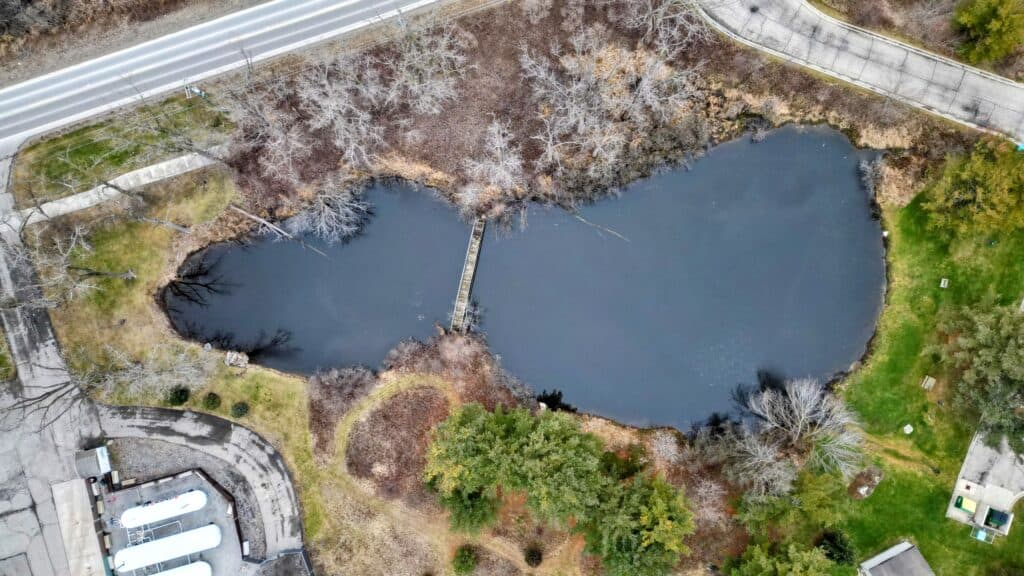
A retention pond is a stormwater basin designed to hold a permanent pool of water. When it rains, runoff flows in, mixes with the pool, and slowly pushes treated water out through an outlet structure. We cover the basics in depth in our guide to the retention pond, so here’s the quick version of how one works.
Runoff from roofs, parking lots, and other impervious surfaces usually reaches the pond through catch basins and storm pipes. From there, it moves through these parts:
- Sediment forebay. A small pool at the inlet traps heavy sediment before it reaches the main pond. EPA recommends sizing it at about 10% of the permanent pool volume (EPA).
- Permanent pool. This is where most of the treatment happens. Particles settle out, and plants and microbes take up nutrients.
- Aquatic bench. A shallow, planted shelf just inside the shoreline. Virginia’s design spec calls for one up to 10 feet wide and no deeper than 18 inches (VA DEQ Spec No. 14).
- Riser and outlet. A control structure that sets the pool elevation and meters out storm volume.
- Emergency spillway. A stabilized overflow path for storms bigger than the pond was designed to handle.
Because the pool never drains, retention ponds are the stronger choice when your permit is driven by water quality. Virginia’s wet pond spec credits up to 75% total phosphorus removal for an enhanced (Level 2) design (VA DEQ Spec No. 14).
What Is a Detention Pond?
A detention pond is a stormwater basin that temporarily holds runoff during a storm and then drains completely. It’s often called a dry pond or dry detention basin. Its main job is to cut the peak flow rate, so a heavy storm doesn’t send a surge of water downstream all at once.
Here’s how it works:
- Runoff fills the basin faster than the outlet can release it, so water “backs up” and is stored.
- A small orifice or weir releases water at a controlled rate. EPA guidance calls for detaining the treated volume for 12 to 48 hours so particles have time to settle (EPA).
- Between storms, the basin is dry. It’s usually a grassy area with a low-flow channel.
Extended detention (ED) ponds hold water longer to boost settling, and many include a small micropool at the outlet to keep the orifice from clogging.
Detention doesn’t have to be a pond at all. Underground detention systems do the same job beneath a parking lot or plaza. That’s why they’re common on dense infill and data center sites where every square foot counts.
Why “Retention” Doesn’t Mean the Same Thing Everywhere
“Retention” can mean two different things depending on who’s talking, and that trips up a lot of project teams. In the Chesapeake Bay region, a retention pond often means a wet pond with a permanent pool that still discharges. In some other jurisdictions, a “retention basin” means a basin with no surface outlet at all, where water only leaves by soaking in or evaporating (Manheim Township, PA).
In D.C., “retention” in the regulations means keeping runoff out of the sewer system for good, through infiltration, evapotranspiration, or reuse. So a retention pond earns no credit toward the District’s Stormwater Retention Volume. DOEE’s guidebook says stormwater ponds “do not receive any stormwater retention value and should be considered only for management of larger storm events” (DC DOEE, Ch. 3.9).
Always confirm how your reviewing jurisdiction defines the term before your engineer sizes anything.
How Do Virginia, Maryland, and D.C. Rules Affect Your Choice?
Your jurisdiction may make the choice for you. Each DMV regulator treats wet and dry ponds differently, especially for water quality credit. Here’s a snapshot:
| Virginia | Maryland | Washington, D.C. | |
| Regulator | Virginia DEQ + local VESMP authority | Maryland Dept. of the Environment + counties | D.C. Dept. of Energy & Environment |
| Wet (retention) ponds | Credited for phosphorus and nitrogen removal; up to 75% TP for Level 2 designs (Spec No. 14) | Wet pond, wet ED, and micropool ED designs are recognized treatment practices (MDE Ch. 3) | Zero retention value; 50% TSS reduction credit; best for larger storms (DOEE Ch. 3.9) |
| Dry (detention) ponds | Used mainly for quantity control; lower treatment credit than wet ponds | “Dry extended detention ponds that have no permanent pool are not considered an acceptable option” for water quality volume (MDE Ch. 3) | No retention value and not an accepted TSS treatment practice; quantity control only (DOEE Ch. 3.12) |
| Required inspections | At least once every 5 years by the VESMP authority or approved professional (9VAC25-875-140) | First year of operation, then at least every 3 years (COMAR 26.17.02.11) | Maintenance covenant required; DOEE can step in if maintenance lapses (DOEE Ch. 3.9) |
| Maintenance agreement | Recorded in land records before permit termination; runs with the land (9VAC25-875-130) | Required through local approval | Recorded covenant specifying maintenance responsibility |
Local rules add another layer, and requirements vary by state and county. Build review time into your schedule. Our guide to navigating local review covers how to keep approvals moving.
Which Pond Is Right for Your Project? 6 Questions to Ask
Choose a retention pond when you need water quality treatment and have the land and drainage area to keep a permanent pool healthy. Choose a detention pond when your main goal is controlling peak flow. Work through these questions with your civil engineer:
- What does your permit need: quality, quantity, or both? Water quality requirements usually point to a wet pond (or a detention pond paired with a treatment practice). Flood control alone can often be met with detention.
- How big is your contributing drainage area? Wet ponds typically need 10 to 25 acres of drainage to hold a stable pool. Smaller “pocket” ponds tend to clog, fluctuate, and cause nuisance problems (VA DEQ Spec No. 14).
- How much land can you give up? Plan on a pond surface area of roughly 1% to 3% of the contributing drainage area (DC DOEE). EPA notes wet ponds are often inappropriate in dense urban areas for this reason.
- What do your soils and groundwater look like? Very sandy soils can struggle to hold a permanent pool. For dry ponds, D.C. guidance calls for the water table or bedrock to sit at least 2 feet below the pond floor.
- How will the pond fit the finished property? A wet pond can be a selling point for a residential community or office campus. A dry basin can double as open space, but it needs to be mowed and kept clean to look intentional.
- Who owns and maintains it long-term? An HOA, property manager, or owner will inherit the maintenance agreement. Make sure they can budget for it.
Quick Takeaway: Retention pond: larger drainage area, water quality credit needed, land available, amenity value wanted. Detention pond: peak flow control is the main goal, lower treatment needs, open space available or underground option preferred.
What If Neither Pond Fits Your Site?
Many DMV sites don’t have room for a pond at all, especially in D.C. and dense Northern Virginia corridors. In those cases, teams often combine options:
- Underground storage. We install underground detention under parking lots and plazas so the surface stays usable.
- Bioretention and rain gardens for water quality in small footprints.
- Permeable pavement that stores and filters runoff under drive aisles.
- Infiltration systems and grass swales to reduce runoff volume at the source.
These low impact development practices are often what earns retention credit in D.C. and water quality credit in Maryland.
What Does Each Pond Cost to Build and Maintain?
Retention and detention ponds cost about the same to build per acre treated, according to EPA’s planning-level ranges. The real difference shows up in long-term maintenance and what you get for the money. Many people assume a dry pond is always the cheaper option, but the national figures don’t bear that out.
| Cost factor | Retention (Wet) Pond | Detention (Dry) Pond |
| Construction | $35,000 to $75,000 per acre of impervious surface treated | $45,000 to $80,000 per acre of impervious surface treated |
| Annual routine maintenance | About 3% of construction cost | About 2% to 6% of construction cost |
| Big-ticket future cost | Forebay and pond dredging | Forebay cleanout; main basin sediment removal every 25 to 50 years |
| Source | EPA Wet Ponds | EPA Dry Detention Ponds |
These are national planning figures. DMV land, labor, and disposal costs can run higher.
Put pond maintenance into your pre-construction budget and into the numbers you hand an HOA or buyer. A pond that looks cheap on the site plan can be expensive over 20 years if nobody planned for sediment removal.
Retention Pond Maintenance vs. Detention Pond Maintenance
Both ponds need routine inspections, debris removal, vegetation care, and periodic sediment cleanout. Retention pond maintenance adds pool-specific work like algae and invasive plant control. Detention ponds need more mowing and close attention to drain-down.
| Task | Retention (Wet) Pond | Detention (Dry) Pond |
| Inspect inlets, outlets, and riser | Quarterly or after storms over 1 inch (VA Spec No. 14) | Annually (EPA) |
| Check embankments for erosion | Quarterly | Semiannually |
| Remove trash and debris | Quarterly | Annually or as needed |
| Mow slopes and buffers | As needed | Annually or more often |
| Algae and invasive plant control | Seasonally | Rarely needed |
| Forebay sediment removal | Every 5 to 7 years, or at 50% full | Every 2 to 7 years, when capacity drops 50% |
| Main pond sediment removal | As needed based on pool depth surveys | Every 25 to 50 years, or at 25% volume loss |
| Comprehensive inspection | Annually | Annually |
Our crews handle inspections, cleaning and sediment removal, and repairs for both types. We also keep the maintenance documentation that inspectors ask for.
Call for an inspection if you notice these warning signs:
- A detention pond still holding water days after a storm
- A retention pond whose normal water level has dropped or keeps rising
- Trash, branches, or sediment piled against the riser or trash rack
- Erosion, slumping, or animal burrows in the embankment
- Algae blooms, odors, or dense invasive plants
- Sinkholes or wet spots near outlet pipes (a CCTV inspection can confirm a pipe problem)
Design for the maintenance truck, not just the storm. A stabilized access road and a forebay that equipment can reach will save thousands on every cleanout.
5 Pond Planning Mistakes We See on DMV Sites
Most pond problems start at design, not in year ten. These are the mistakes that cost owners the most:
- Undersizing the forebay. Sediment that skips the forebay ends up in the main pool, and dredging a whole pond costs far more than cleaning a forebay.
- Forgetting equipment access. If a vac truck or excavator can’t reach the outlet or forebay, every maintenance visit costs more.
- Choosing a wet pond for too small a drainage area. Without enough inflow, the pool drops in summer, algae takes over, and the “amenity” turns into a complaint.
- Leaving construction sediment behind. Temporary sediment basins are sometimes converted to permanent ponds. Skipping a thorough cleanout and slope stabilization during conversion can shorten the pond’s life. It can also hold up bond release.
- Handing off without a plan. In Virginia, the maintenance agreement has to be recorded before permit termination (9VAC25-875-130). Give the future owner a schedule and a budget, not just a document.
Wet, Dry, or Underground: Build the Pond Your Site Can Live With
The retention pond vs. detention pond decision comes down to your site’s needs. Choose a retention pond when you need water quality treatment and have the drainage area and land to support a permanent pool. Choose a detention pond, above ground or below, when peak flow control is the priority. Then check what your jurisdiction credits. In D.C. and Maryland especially, the rules can rule out an option before design starts.
Whichever you build, plan for maintenance from day one. It’s what keeps a pond working, compliant, and off the inspector’s list.
Keep Your Stormwater Ponds Working with Muller, Inc.
Muller, Inc. started in 2007 with two pickup trucks, a couple of laborers, and one skid steer. Today we’re a full-service civil construction company headquartered in Reston, Virginia, with a construction yard in Manassas. We help property owners, developers, and managers across the Mid-Atlantic keep their stormwater systems working and compliant.
What we bring to your ponds and BMPs:
- One team for the whole life cycle: from turnkey site development and installation to long-term care
- Inspections, cleaning, and repair for wet ponds, dry ponds, underground detention, bioretention, and proprietary systems
- Compliance reporting built around VESMP, MDE, DOEE, and MS4/NPDES requirements
- A recurring stormwater maintenance program so inspections and cleanouts happen on schedule, not after a violation
- Mid-Atlantic coverage across Virginia, Maryland, D.C., and neighboring states
Planning a new basin or inheriting an old one? Talk to a team that builds and maintains them every day. Request an estimate today!
Retention Pond vs. Detention Pond FAQs
How long should a detention pond hold water? Most dry detention ponds are designed to drain within about 12 to 48 hours after a storm. If yours still holds water days later, the outlet may be clogged and should be inspected.
How can you tell if a pond is a retention pond? If it holds water between storms, it’s most likely a retention (wet) pond. A grassy basin that sits dry except after rain is a detention pond.
How deep is a retention pond? EPA guidance puts the optimal permanent pool depth at about 3 to 10 feet (1 to 3 meters), though the design depth depends on the site and local standards (EPA).
Who is responsible for maintaining a retention or detention pond? Usually the property owner or HOA named in the recorded maintenance agreement. Local authorities inspect the pond and can require repairs if it isn’t maintained.
Is a retention pond or detention pond cheaper to build? EPA’s national ranges put them close: about $35,000 to $75,000 per acre of impervious surface treated for wet ponds and $45,000 to $80,000 for dry ponds. Your site’s soils, size, and local standards will drive the real number, so request an estimate for your project.