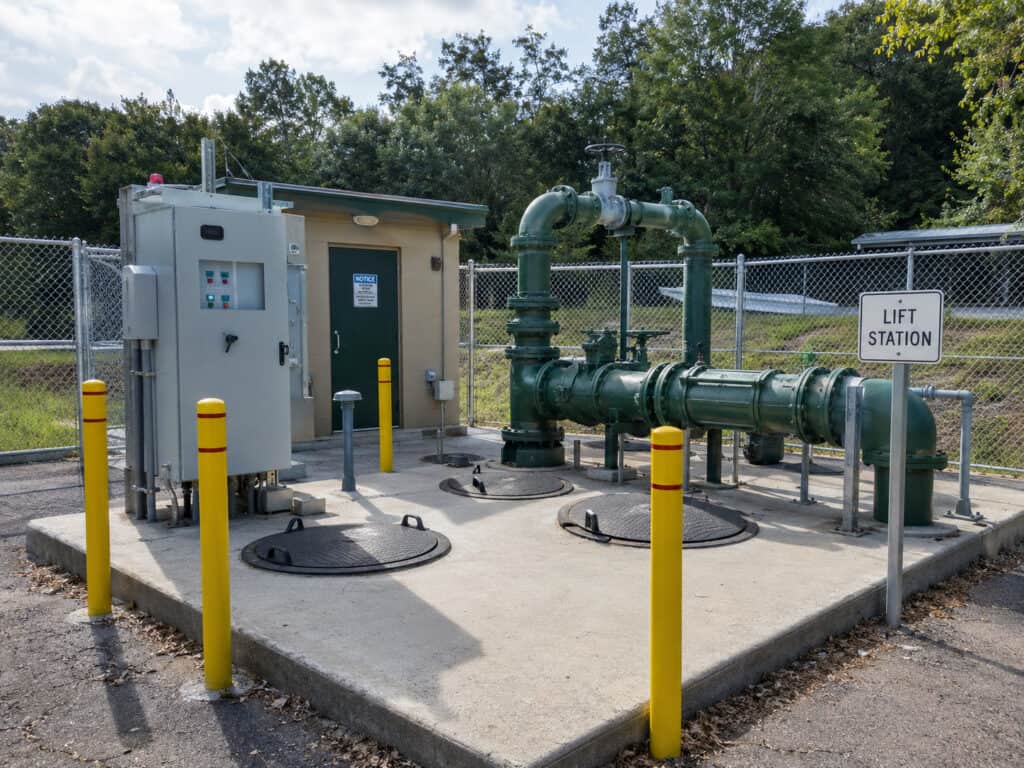
A lift station is a pump system that moves wastewater from a lower elevation to a higher one when gravity alone can’t get the job done. You’ll find them anywhere flat terrain, a high water table, or a deep basement level makes a standard gravity sewer connection impractical or too expensive to build.
If you’re planning a development site in the DMV region, understanding how lift stations work, and whether your site actually needs one, can shape everything from your utility budget to your project timeline.
This guide breaks down the mechanics, the components, and the real-world decision points that determine whether a lift station belongs in your site design.
Quick Overview
| Question | Quick Answer |
| What is a lift station? | A pump system that moves wastewater to a higher elevation when gravity flow isn’t possible |
| Why would a site need one? | Flat or low-lying terrain, a high water table, deep basement-level fixtures, or excessive gravity-line excavation depth |
| What’s inside one? | A wet well, one or more pumps, a control panel and alarm system, and discharge piping into a force main |
| Lift station vs. pump station? | A lift station is a type of pump station built specifically for wastewater and sewage; “pump station” is the broader category |
| Who decides if a site needs one? | Typically determined during civil engineering design, based on site topography and existing utility elevations |
What Is a Lift Station?
A lift station, sometimes called a sewage pump station or wastewater lift station, is a mechanical system that collects wastewater in an underground basin and pumps it to a higher point in the sewer network. From there, gravity can take back over, or the flow continues toward a treatment plant.
Lift stations aren’t the same as a septic system, and they don’t treat wastewater. Their only job is transport: moving sewage past a low point in the terrain so it can keep flowing toward its destination. On a development site, that usually means connecting a building’s sanitary service lines to the public sewer system when the site’s elevation won’t allow a straight gravity run.
How Does a Lift Station Work?
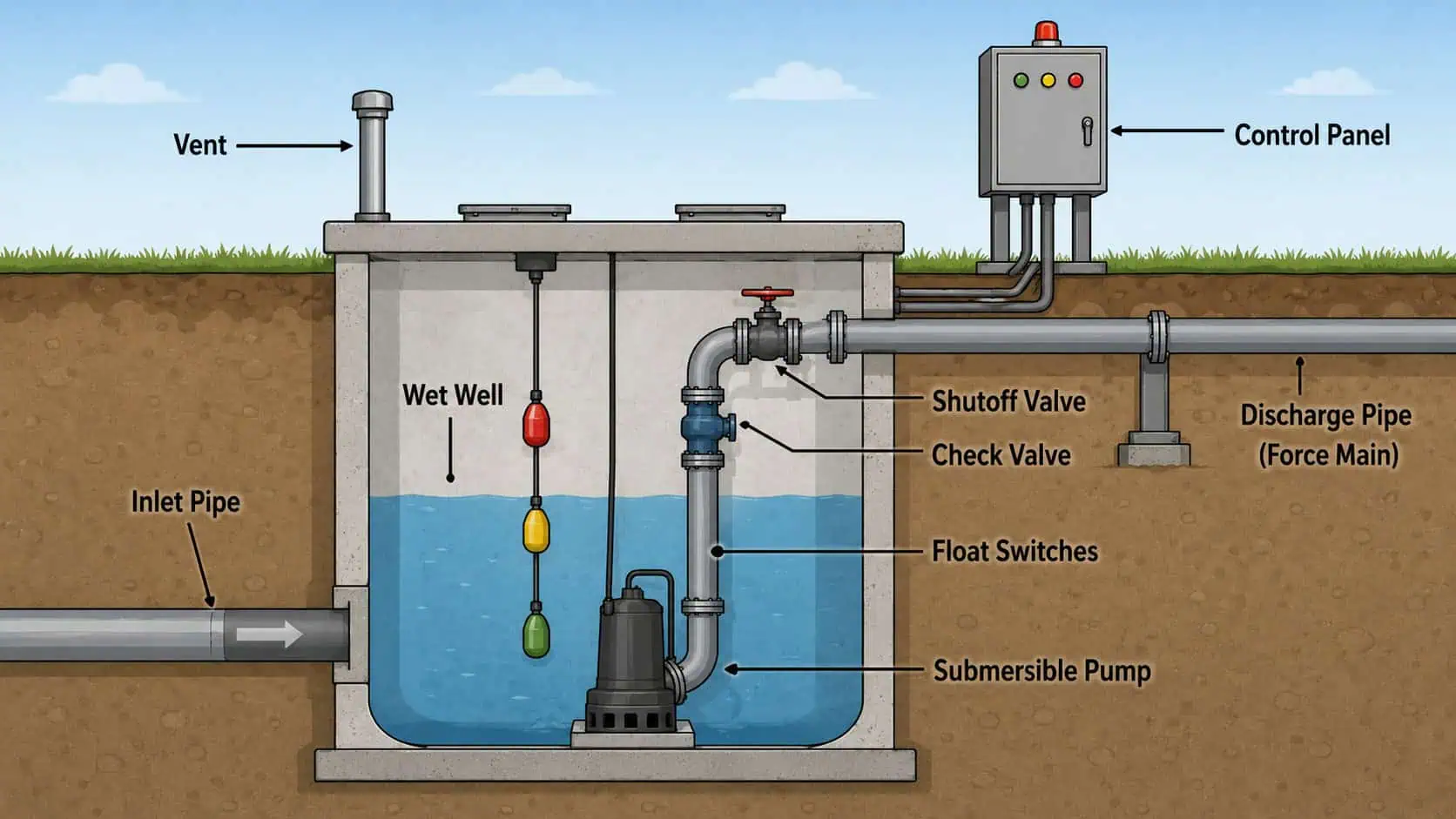
A lift station operates on a simple, repeating cycle:
- Wastewater flows into an underground holding basin called the wet well.
- Level sensors or float switches monitor the wastewater level inside the wet well.
- Once the level reaches a set point, one or more pumps activate.
- The pumps push wastewater through discharge piping into a force main, which carries it under pressure toward a gravity connection or treatment facility.
- As the wet well drains, the pumps shut off, and the cycle starts again.
This cycle repeats continuously as wastewater enters the system, which is why reliable pumps, controls, and backup power matter so much to a lift station’s long-term performance.
What Are the Main Components of a Lift Station?
A lift station is a fairly compact system, but every component plays a specific role in keeping wastewater moving safely and reliably. A typical setup includes:
- Wet well: the underground basin that collects and temporarily holds incoming wastewater
- Pumps: usually submersible units, often installed in pairs for redundancy so one pump can keep running if the other needs service
- Control panel: manages when the pumps turn on and off based on wet well levels
- Level sensors or float switches: trigger the pumps at the correct water level
- Alarm system: alerts operators to high water levels, pump failures, or power loss
- Backup power: keeps the station running during an outage so wastewater doesn’t back up or overflow
- Discharge piping: carries pumped wastewater into the force main
Each of these components has to be sized and coordinated correctly during design. A lift station that’s undersized for its service area, or missing reliable backup power, is far more likely to cause problems down the line.
Wet Well vs. Dry Well Lift Stations
Lift stations are generally built one of two ways, and the difference comes down to where the pump sits relative to the wastewater.
| Configuration | How it works | Where it’s typically used |
| Submersible (wet well) | The pump sits directly inside the wet well, submerged in the wastewater | Most common configuration on commercial and residential development sites; smaller footprint, fewer above-grade components |
| Dry well (dry pit) | The pump sits in a separate, dry chamber and connects to the wet well through suction piping | More common on larger municipal or industrial systems where easier dry-side access simplifies maintenance |
Submersible wet well stations have become the more common choice for site development projects because they require less space and hold up well with routine maintenance.
Lift Station vs. Pump Station: What’s the Difference?
A lift station is a specific type of pump station built to move wastewater and sewage rather than clean water. “Pump station” is the broader term, covering systems that move any fluid, including potable water, stormwater, or irrigation water, over distance or elevation.
The practical differences show up in how each system is built:
- What they move: Lift stations handle raw sewage, which contains solids and debris. Pump stations often move cleaner fluids, though some pump stations are also designed for wastewater.
- Pump type: Lift stations typically use grinder or solids-handling pumps designed to process debris without clogging. Clean-water pump stations don’t need this feature.
- Safety requirements: Because sewage generates hazardous gases, lift stations require ventilation and hazardous-location electrical equipment that a standard pump station may not need.
In short, every lift station is a pump station, but not every pump station is a lift station. If a project calls for moving sewage uphill, “lift station” is the more accurate term.
When Does a Site Need a Lift Station?
Gravity flow is almost always the simpler, lower-maintenance option, so engineers default to it whenever a site allows. A lift station becomes necessary when the site’s elevation and layout make a gravity connection impractical. Common triggers include:
- Flat or low-lying topography that doesn’t provide enough natural fall to reach the gravity sewer main
- A high water table, which can compromise a deep gravity line or make excavation impractical
- Basement-level or below-grade fixtures, such as parking garages or lower-level commercial space, sitting below the elevation of the public sewer
- Excessive gravity-line excavation depth, which drives up trenching, shoring, and dewatering costs
- Long distance to the nearest gravity connection point, where maintaining slope over that distance would require burying the line far deeper than is practical
These factors are usually weighed against each other during civil design. A site with a modest elevation problem over a short distance might still make sense as a deep gravity run, while a flat site with below-grade fixtures and a long distance to the sewer main will often come out cheaper, and more reliable long-term, with a lift station.
That tradeoff is really a cost-of-excavation-versus-cost-of-equipment decision. Deep trenching, shoring, and dewatering on a gravity-only design can add significant cost as depth increases, while a lift station shifts some of that upfront excavation cost into equipment and ongoing operation and maintenance.
Who Decides Whether a Lift Station Is Needed?
This determination is typically made early, during civil engineering and site development design, once the engineer has topographic survey data and knows the elevation of the existing public sewer at the property line. From there, the design team evaluates whether a gravity connection is feasible or whether a lift station is the more practical path.
Public utility authorities in the region generally review and approve lift station design before construction begins, and ongoing operation and maintenance responsibilities are typically addressed as part of that approval. Coordinating this early, alongside the rest of the utility design covered in our regulatory guidance for site development projects, helps avoid redesign later in the process.
Lift Station Maintenance: What Ongoing Care Looks Like
A lift station is only as reliable as its maintenance schedule. Deferred maintenance is one of the leading causes of pump failure and, in the worst cases, sanitary sewer overflows, which the EPA identifies power failures and equipment malfunctions as a documented cause of.
Routine lift station maintenance typically includes:
- Regular wet well cleaning to prevent grease and solids buildup
- Periodic pump and impeller inspection to catch wear before it causes a failure
- Check valve inspection to prevent wastewater from backflowing into the wet well
- Control panel and alarm system testing to confirm alerts trigger correctly
- Backup power testing to verify the station stays operational during an outage
Staying ahead of these items costs far less than responding to an emergency pump failure, and it protects the site from the odor, backup, and compliance risks that come with a failed lift station.
Where Lift Stations Fit Into Site Development
Lift stations aren’t typically designed or installed as a standalone project. They’re one piece of the broader utility package that goes into a site during development, alongside sanitary sewer mains, gravity sewer mains, and force main connections. Coordinating lift station design with the rest of the site’s wet utility installation helps keep elevations, tie-in points, and construction sequencing aligned from the start, rather than solving for a low spot after the rest of the utility layout is already set.
This is also why flat or low-lying sites, such as data center developments, so often end up needing lift stations. Large, single-story footprints with minimal natural grade change are exactly the conditions where gravity flow runs out of room to work.
At Muller, our utilities team handles this coordination directly, from evaluating whether a site needs a lift station through design support, installation, and long-term maintenance.
Talk to Us About Your Site’s Utility Needs
Muller has installed and maintained sanitary sewer infrastructure, including lift stations, force mains, and gravity systems, across commercial, residential, and government sites throughout the DMV region. Whether you’re still weighing whether your site needs a lift station or you’re ready to move into design and installation, our utilities team can walk through the options with you.
Frequently Asked Questions
Is a lift station the same as a sewage pump station? Yes. “Sewage pump station” and “wastewater lift station” both refer to the same type of system: one built specifically to pump sewage to a higher elevation. The terms are used interchangeably across the industry.
Does a lift station need a permit? In most jurisdictions, yes. Lift stations are typically reviewed and approved by the local utility authority as part of the site’s overall utility design before construction begins.
Can a lift station serve a single building, or only larger developments? Lift stations can serve anything from a single building with below-grade fixtures to an entire development. Sizing and pump capacity are determined by the volume of wastewater the station needs to handle, not the number of buildings connected to it.
What happens if a lift station loses power? Without backup power, wastewater keeps collecting in the wet well and can eventually overflow. That’s why properly sized generator or battery backup, paired with a working alarm system, is such a critical part of lift station design.
How is a lift station different from a septic system? A septic system treats and disperses wastewater on-site, while a lift station only transports wastewater to keep it moving toward the public sewer or a treatment plant. A lift station doesn’t treat sewage at all.