A grinder pump is a wastewater pump that shreds solids into a fine slurry and pushes that slurry under pressure through a small pipe to a sewer main sitting higher up or farther away than gravity can reach. On a site plan it shows up where a straight gravity run was expected, usually because grade, depth, or distance to the connection point will not allow one.
On most commercial projects in the D.C. region, a grinder pump isn’t the first choice. A gravity connection is, and when a site sits below the sewer main, a duplex lift station usually comes next. Grinder pumps fit specific situations such as small buildings and outparcels far from the main, long or uphill runs, constrained sites, and low-pressure sewer networks on some larger developments.
The pump itself is rarely the hard part. The questions that actually affect a project are where it sits in the larger system, which pipe it feeds, who owns and maintains it after acceptance, and what it does to the capital and lifecycle cost of the collection system. This guide answers each of them.
This guide follows wastewater from the building drain to the treatment plant rather than stopping at the pump, because a grinder pump is a component inside a network, not a standalone appliance. That view comes from installing these systems alongside the rest of the wet utilities on commercial, institutional,municipal, and large residential development sites across Washington, D.C., Maryland, and Virginia,, and from going back with cameras and jet trucks when one of them stops working.
At a Glance
| Question | Short answer |
| What does it do? | Grinds wastewater solids into slurry, then pumps that slurry under pressure |
| Where does it sit? | In a sealed basin below the building’s lowest drain, typically buried outside the structure |
| Why does it exist? | The sewer main is uphill, too far away, or too shallow for gravity flow |
| What does it discharge into? | A small pressurized force main, which feeds a gravity sewer main or a lift station |
| How big is the discharge pipe? | As small as 1 1/4 inches at the building connection, with 2-inch and larger mains downstream |
| Simplex or duplex? | Small single connections often use one pump. Most commercial sites and many utility standards call for two. |
| What does it cost? | It depends on density and ground conditions. Pressure systems usually cost less to build at low density, while gravity wins as density increases. |
| How often does it need service? | Roughly every 4 to 10 years between service calls on a quality installation, according to EPA guidance. |
What Is a Grinder Pump?
A grinder pump is a submersible wastewater pump with a cutting assembly at its intake. It reduces everything arriving from the building, solids included, into a slurry fine enough to travel through a pipe only 1 ¼ to 2 inches in diameter, then pressurizes that slurry and sends it on toward the sewer main.
Three components do the work:
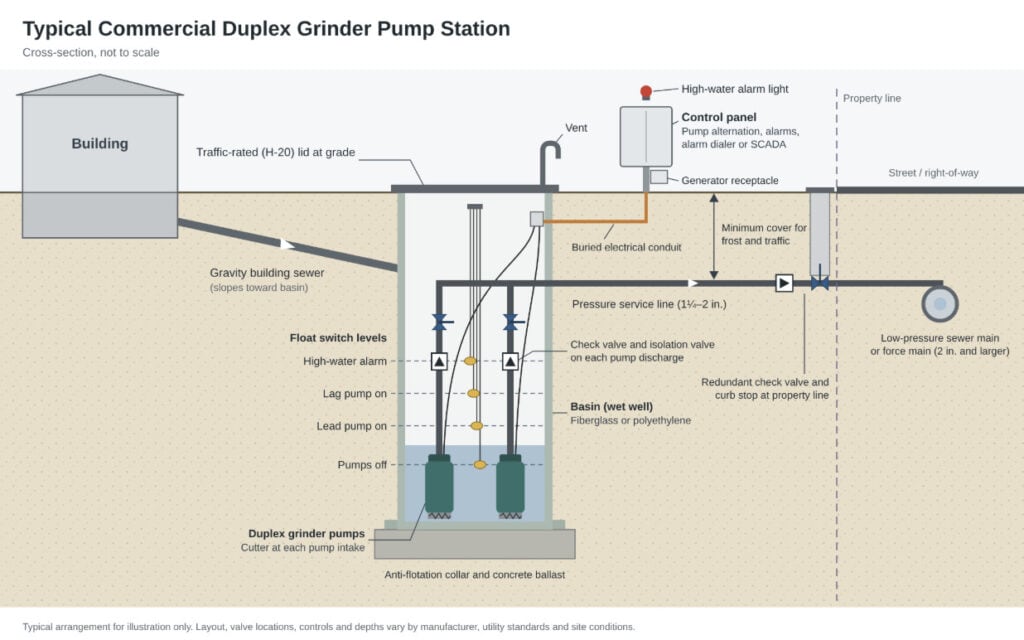
- The basin, also called a wet well or holding tank. This is a sealed fiberglass, polyethylene or concrete vessel buried below the building’s lowest drain line, sized to hold incoming flow between pump cycles, plus reserve storage above the alarm level
- The grinder assembly, a hardened rotating cutter paired with a stationary shredder ring. It slices solids apart before they ever reach the impeller.
- The pump and controls, meaning a submersible motor, a float switch or pressure sensor that starts and stops each cycle, and a high-water alarm. On commercial sites, the controls usually sit in a control panel with an alarm dialer or a SCADA (supervisory control and data acquisition) connection back to the operator
That combination is what separates a grinder pump from everything else on a site. No other building-scale pump both cuts and pressurizes.
How Does a Grinder Pump Work?
A grinder pump runs a short four-stage cycle. Cycles are short, often a minute or two, and how often they happen rises and falls with the building’s water use. A busy commercial station can cycle many times an hour at peak. Between cycles it sits idle while the basin refills.
Here is what happens each time it runs:
- Collect. Wastewater flows by gravity from the building’s fixtures through the lateral and into the basin. Nothing is pumped yet.
- Grind. When the liquid reaches the start level, the float or sensor closes the circuit and the motor spins up. The cutter and shredder ring reduce solids to a slurry.
- Pressurize. The impeller builds enough pressure to overcome both the vertical lift and the friction in the discharge pipe. On a low-pressure network it also has to overcome whatever pressure other pumps on the network are already putting into the same main.
- Discharge. The slurry leaves through a check valve and into the discharge line. When the basin drops to the stop level, the pump shuts off and the check valve closes so nothing flows back.
The check valve matters more than it sounds. It is the single component that keeps a pressurized main from draining back into the basin every time the pump stops, and it is a common failure point on older installations. On low-pressure networks, a second check valve and a curb stop (shutoff valve) are usually installed at the property line, so one connection can be isolated without shutting down the main.
Centrifugal vs. Semi-Positive Displacement Grinder Pumps
Grinder pumps come in two basic designs, and they respond differently to pressure. A centrifugal grinder pump delivers more flow at low head, and its flow drops as discharge pressure rises. A semi-positive displacement (SPD) pump holds its flow nearly constant across a wide pressure range. Both are used on shared low-pressure networks; each calls for a different design approach.
| Centrifugal grinder pump | Semi-positive displacement (SPD) | |
| Flow behavior | Flow falls as discharge pressure rises; high-head models have steeper curves | Nearly vertical pump curve, so flow stays close to constant |
| Typical output | Higher flow at low head; varies widely by model | Around 15 gpm maximum, roughly 11 gpm at 40 psi |
| Pressure rating | Varies by model; high-head units are built for longer runs and higher lifts | Rated to roughly 185 feet of total dynamic head, about 80 psi |
| On shared networks | Works when the network is modeled and pumps are matched to it | More forgiving when many pumps discharge at once |
| Relative equipment cost | Generally lower | Generally higher |
| Where it gets specified | Single buildings, duplex commercial stations and modeled networks | Large low-pressure networks such as subdivisions and campuses |
Performance figures above come from the E/One low-pressure sewer design guidelines published by Metro Nashville.
The choice matters most on shared networks. Whichever type is specified, the network needs a hydraulic analysis that checks how many pumps may run at once at peak, the pressure in the main at each connection, and whether each pump can still deliver enough flow against it. Skipping that analysis is what leads to long run times, overheated motors and early callbacks.
Grinder Pump vs. Sewage Ejector Pump vs. Sump Pump
These three get mixed up constantly, and the mix-up costs money. A grinder pump shreds sewage and pushes it under pressure over distance or uphill. A sewage ejector pump passes solids through whole on a short lift into a nearby gravity line. A sump pump moves clear groundwater and should never handle sewage at all.
| Grinder pump | Sewage ejector pump | Sump pump | |
| What it moves | Raw sewage, ground into slurry | Raw sewage, solids passed whole | Clear groundwater and seepage |
| Solids handling | Cuts solids apart before pumping | Passes solids up to about 2 inches | None. Solids will destroy it |
| Discharge pipe | 1 1/4 to 2 inches | 2 to 4 inches | 1 1/2 to 2 inches |
| Where it discharges | A pressurized force main, often uphill or a long distance | A gravity sewer line a short lift away | Storm drain, dry well or daylight, as local code allows |
| Typical horsepower | 1 to 2 hp on buildingsmall connections, higher on commercial stations, often three-phase | 1/2 to 1 hp | 1/3 to 1/2 hp |
| Typical application | A building below the sewer main, or any connection on a low-pressure sewer network | A below-grade restroom, locker room or mechanical room draining to a gravity line just above it | Elevator pits, below-grade mechanical rooms and foundation drainage |
Why the Confusion Persists
Part of it is vocabulary. “Sewage pump” gets used to mean an ejector pump in one conversation and a grinder pump in the next, and neither speaker is wrong exactly, because both move sewage. The equipment is not interchangeable, though, and the difference is the discharge side.
So when a utility says the site needs a grinder pump and the plumbing design calls for a sewage ejector, they are usually not disagreeing about the pump. They are disagreeing about what it connects to. A utility asking for a grinder pump is telling you the connection point is a pressurized main, which requires a pump that can push against pressure. An ejector pump isn’t built for that job.
The practical test is simple: find out what the pump discharges into before you specify one. If the answer is a pressurized line shared with other connections, it is a grinder pump. If the answer is a gravity line a few feet up and a few feet over, an ejector will do.
Where a Grinder Pump Fits in a Wet Utility System
A grinder pump is the handoff point between gravity and pressure. Everything upstream of it moves because of slope. Everything downstream of it moves because the pump is pushing. Understanding that handoff explains almost every design decision around it.
Here is the full path wastewater takes:
- Fixtures and building drains. Sinks, toilets and floor drains feed the building’s internal drain system by gravity.
- The building lateral. A sloped pipe carries flow out of the building and into the basin. This is still gravity, and it is still the property owner’s pipe.
- The basin. Flow collects here between cycles. Basin size is a design decision, not a default, because it determines how much reserve storage the station has during a power failure or pump outage.
- The grinder pump. Solids are cut, slurry is pressurized, and the system switches from gravity to pressure at this exact point.
- The service line. A small pressurized pipe, commonly 1 1/4 inches for a single building connection, runs from the basin to the main.
- The force main. The slurry joins a pressurized force main, which the EPA notes is typically 2-inch or larger PVC in pressure sewer applications. HDPE is also common, especially where the main is installed by directional drilling. Unlike a gravity pipe, a force main can follow the contour of the ground, climb hills, and run shallower, at the minimum cover needed for frost and traffic protection.
- The discharge manhole or lift station. The force main gives up its pressure into a gravity sewer main or a larger pumping station.
- The treatment plant. From there, everything travels the conventional route.
Steps five through seven are where most of the risk lives. A pump can be sized perfectly and still fail the site if the force main is undersized, missing air release valves at its high points, or discharged into a manhole that cannot handle the turbulence.
Grinder Pumps and Low-Pressure Sewer Networks
When many connections share one pressurized main, the result is a low-pressure sewer system, and the grinder pump stops being a building appliance and starts being a node on a network. Large residential subdivisions and multi-building campuses are the most common examples. The EPA’s technical guidance on pressure sewers lays out where these systems make sense:
- Connection density is low, so gravity trunk lines would run long and lightly used
- The terrain has significant elevation change, which a gravity system would answer with deep cuts or extra lift stations
- The ground is flat but the water table is high or bedrock is shallow, making deep gravity trenching expensive
- Rights of way are constrained, and a shallow 2-inch main can follow a route a 12-inch gravity pipe cannot
What they are not good for is dense development on cooperative ground. The EPA is direct about the trade-off: operating cost for a pressure system runs higher than a conventional gravity system, because there are simply more pumps to maintain. Where gravity works, gravity wins, which is the same conclusion we reach comparing gravity sewers and force mains on real sites.
One design detail deserves more attention than it usually gets. A pressure main has to scour itself. EPA guidance recommends that grinder pump systems reach three to five feet per second at least once per day, which means the main has to be sized for the flow it will actually see, not the flow the buildout projection promises. Oversize a main to accommodate a phase two that gets delayed three years, and solids settle in it in the meantime.
What Virginia, Maryland and D.C. Require
Most individual grinder pumps serving a single building are governed by the plumbing code and the local utility’s standards. Larger stations, and those serving multiple connections, can fall under state sewerage regulations. For anything that meets the state’s definition of a sewage pumping station, Virginia’s sewerage regulations under 9VAC25-790 set specific expectations. Three of them shape design most often:
- Redundancy. At least two pumping units, each capable of handling flows above the expected maximum or a minimum of 2.5 times the average design flow, whichever is greater.
- Alarms. High-water alarms where backup or overflow is a risk, and for duplex stations, an alarm that fires when both pumps run at the same time.
- Wet well behavior. The station has to be designed and operated to avoid heat buildup from frequent motor starts, and to avoid septic conditions from wastewater sitting too long.
That last requirement is the one that quietly drives basin sizing. A basin too small short-cycles the motor. A basin too large lets wastewater go septic, which produces hydrogen sulfide, which corrodes the downstream system. These same force main failure modes show up years later as pipe bursts, and they usually trace back to a decision made at design.
In Maryland, the Maryland Department of the Environment’s design guidelines and utility standards such as WSSC’s apply. In Washington, D.C., DC Water sets the requirements. Local authorities layer their own standards on top of the state code, and in the greater DC metro region those vary meaningfully between jurisdictions. Confirming the specific requirements early is part of planning a sanitary sewer installation properly, along with potholing to verify where the existing utilities actually sit before anything gets designed around them.
When Does a Site Need a Grinder Pump?
Engineers look at gravity first, because it has no pumps to power or maintain. When the building sits below the main, the next option is usually a duplex lift station. A grinder pump makes sense when the flow is small and the route is the problem: gravity can’t reach the connection point, or getting there by gravity costs more than pumping. Five conditions account for nearly all of them:
- The building sits below the sewer main. Below-grade levels, loading docks, parking structures and buildings on a downslope lot all drain lower than the street. Gravity will not carry flow uphill.
- The main is a long way off. On low-density parcels and outparcels, a gravity run to the nearest connection would need depth the site cannot give it without deep cuts the entire way.
- The terrain rolls. Gravity sewer needs consistent fall in one direction. Ground that rises and falls forces either deep trenching or a series of lift stations, and a shallow pressure main sidesteps both.
- The water table is high or bedrock is shallow. Deep trenching gets expensive fast when crews hit rock or have to dewater continuously. A 2-inch main at shallow depth avoids most of that cost.
- The right of way is constrained. Existing utilities, mature trees, easement limits or a road the jurisdiction will not let you cut. A small-diameter pressure line can thread a route a large gravity pipe cannot.
Those conditions show up constantly on infill parcels, campus expansions, outparcels on large commercial developments and residential subdivisions on rolling ground, where the sanitary load is modest but the available routing is not. If a site under design looks like it is heading this direction, it is worth settling the question before the sanitary sewer installation is drawn, not after.
Commercial and Subdivision Grinder Pump Stations
A grinder pump on a commercial site or a subdivision is a different design problem from a single small connection. These items shape the station:
- Simplex or duplex. A duplex station has two pumps that alternate, and either one can carry the load if the other fails. Most commercial sites, and many utility standards, call for duplex. Confirm the requirement with the reviewing authority early.
- Sizing to peak flow. Stations are sized to the building’s peak flow, calculated from fixture units or the utility’s design flow criteria, not to the average day.
- Power and controls. Commercial pumps are larger and often three-phase. The control panel typically includes pump alternation, high-water and pump-fail alarms, and an alarm dialer or SCADA connection back to the operator.
- Standby power. A generator receptacle, transfer switch or permanent generator keeps the station running through an outage. Some sites use added emergency storage instead.
- Traffic-rated lids. A basin in a parking lot or drive aisle needs a lid and frame rated for traffic loads, typically H-20.
- Buoyancy. An empty basin in high groundwater can float. Anti-flotation collars, concrete ballast or a concrete base keep it in place.
- Valves and access. Isolation and check valves are often placed in a separate valve vault, so crews can service them without entering the wet well.
- Grease control. Food service connections need a grease interceptor upstream of the basin.
For large residential developments, the questions shift to the network: hydraulic modeling of the shared pressure main, how phases are built and connected over time, and who owns the system after turnover. In much of the region, grinder pumps on subdivisions are privately owned, usually by the HOA, so maintenance agreements, easements and as-builts need to be
What Does a Grinder Pump System Cost?
There’s no reliable per-unit number for a commercial grinder pump system, because the pump is rarely what drives the cost. Published benchmarks mostly come from older, low-density residential sewer projects, so they don’t translate to a commercial site or a modern subdivision. What holds up is the pattern: a pressure system replaces manholes, deep trench and lift stations with a pump at each connection. That trade tends to favor pressure at low density and on difficult ground, and to favor gravity as density rises.
What Moves the Number on a Commercial Project
Four variables explain most of the spread between a project at the low end of the cost range and one at the high end:
- Pipe and depth, not pumps. Linear footage and trench depth drive the number far more than pump selection does. A route that stays shallow is the single biggest cost lever on the job.
- Ground conditions. Rock, a high water table and continuous dewatering turn a predictable trench into an hourly problem. This is where an accurate utility locate and a realistic geotech report earn their keep several times over.
- Electrical service and controls. Every station needs power, an alarm circuit and in many cases SCADA or telemetry back to the operator. On a site without nearby service, the electrical scope can rival the pump scope.
- Redundancy and jurisdictional requirements. A duplex station with standby provisions costs substantially more than a simplex one, and whether you need it is a code question answered by the reviewing authority, not a preference.
Lifecycle cost runs the other direction, and it is the part owners underestimate. EPA guidance has estimated routine maintenance at $100 to $200 per unit per year, and states directly that operating cost for a pressure system runs higher than a conventional gravity system, simply because there are more pumps to maintain. Capital savings at construction can be eroded by higher operating costs over the service life, so the honest comparison is total cost of ownership over twenty years, not the bid tab. On a subdivision, that cost often lands on the HOA, so it belongs in the HOA budget from the start.
Maintenance, Alarms, and What Failure Looks Like
Most grinder pump failures are not mechanical. They happen because something entered the basin that the cutter was never designed to handle, and the pump either jams or wears out early trying to process it.
What Should Never Go Into a Grinder Pump
The cutter will attempt almost anything, which is exactly the problem. Keep these out of the system:
- Wipes of any kind, including those marketed as flushable
- Shop rags, mop heads and paper towels
- Nitrile and latex gloves
- Feminine hygiene products
- Food waste and grease from kitchens without a grease interceptor
- Lint and fibers from commercial laundries
- Sand, grit and debris from floor drains, area drains and wash bays
- Paint, solvents, fuel and other petroleum products
- Strong cleaning and sanitizing chemicals, which attack seals and the pump housing
Storm drains, roof drains and sump pumps should never be connected to a grinder basin. Clear water uses up pump capacity and can overwhelm the station during a storm.
The Alarm Is Sounding. Now What?
A grinder pump alarm means the basin is filling faster than the pump is emptying it. It is a warning with some time built into it, not an immediate emergency, because basins are sized to hold reserve capacity above the alarm level. Work through these four steps:
- Check the control panel. Note which alarm is active (high water, pump fail or seal fail) and whether the alarm dialer or SCADA has already notified the operator.
- Cut flow into the system. Shut down non-essential water use: irrigation, wash bays, laundry, anything that adds volume. Every gallon added shortens the time available to fix the problem.
- Check the breaker or disconnect. A tripped breaker is the most common cause and the easiest fix. Reset it once. If it trips again, leave it off and call for service.
- Stop cycling power. Silencing the alarm is fine if there is a silence button. Repeatedly cycling power to a pump that is jammed can burn out the motor and turn a service call into a replacement.
- Call whoever owns the pump. That is either the utility or a contractor under a service agreement, depending on how the system was set up. More on that below.
Catching a problem before the alarm is better, and the pump usually gives warning. Watch for run times that keep getting longer, cycles that start happening more often than they used to, gurgling or slow drains inside the building, odor near the basin lid, or a breaker that trips intermittently.
How Long Does a Grinder Pump Last?
The EPA’s pressure sewer guidance puts the mean time between service calls at four to ten years for quality installations, covering both grinder pump and septic tank effluent pump systems. Cutters and seals are wear items, so the pump is rarely replaced whole. What separates the four-year installations from the ten-year ones is usually what went into the basin and whether the electrical was done properly the first time.
On municipal and campus systems, the same logic applies at scale. Scheduled CCTV inspection of the downstream main and periodic cleaning with jet vac trucks catch buildup while it is still buildup, rather than after it becomes a blockage and a backup.
Who Owns and Maintains the Pump?
Ownership depends entirely on how the system was set up, and it is worth confirming in writing rather than assuming. Two arrangements are common.
- Privately owned. The pump sits on private property, serves one building, and the owner is responsible for power, maintenance and replacement. This is the default for a single building lifting into a nearby gravity main.
- Utility owned or utility maintained. On many low-pressure sewer networks, the utility owns the pump and basin even though they sit on private property, maintains them under a dedicated easement, and recovers the cost through a monthly surcharge. The property owner still supplies the electricity and still has to keep the area clear. This arrangement is common in some parts of the country. In much of the greater D.C. region, though, utilities require grinder pumps to be privately owned and maintained by the property owner on a commercial site, or by the HOA on a subdivision.
Either arrangement comes with site obligations that get violated routinely once landscaping and paving go in. Keep trees and large shrubs off the basin and the service line. Do not pave, fence, or build structures over them. Keep the lid accessible and leave enough clearance for a service truck, because a crew that cannot reach the pump cannot fix it.
For developers, ownership is a punch list item, not a footnote. Easements have to be recorded, as-builts have to reflect what was actually installed, and the stations have to be tested and accepted.
Planning a Grinder Pump or Low-Pressure Sewer System?
Muller builds the whole system, not just the pump.
We install wet utilities across Washington, D.C., Maryland and Virginia: sanitary sewer, water, and storm drain, from the building lateral through the force main to the connection at the public main. For commercial sites and large residential developments, grinder pump stations and low-pressure networks sit in the middle of that scope, and the same crews come back with jet vac trucks and CCTV cameras when a line needs cleaning, inspection or repair. One contractor stays accountable for the system from site development through bond release.
If a site under design is heading toward a pressure solution, the cheapest moment to get it right is before the plans are stamped. Request an estimate today.
Grinder Pump FAQs
What is the difference between a grinder pump and a lift station? The difference is scale. A grinder pump station handles small to moderate flows, grinds solids and discharges through small-diameter pressure pipe. A lift station handles larger flows from many connections, typically with solids-handling pumps and a larger force main. Both are commonly built as duplex stations, and some lift stations use grinder pumps.
What does a commercial grinder pump station cost? It depends mostly on what surrounds the pump: simplex or duplex, basin depth and size, the length and depth of the pressure main, ground conditions, electrical service, controls and standby power. Replacing a pump in an existing basin costs far less than a new station, because the basin, piping and electrical are already in place.
How far can a grinder pump push sewage? A semi-positive displacement grinder pump is typically rated to about 185 feet of total dynamic head, roughly 80 psi, which covers real distance and elevation. High-head centrifugal grinder pumps are also built for long runs and higher lifts. Actual reach depends on pipe diameter, friction losses and how many other pumps share the low-pressure sewer main.
What happens to a grinder pump during a power outage? The pump stops and the basin holds whatever arrives until power returns, which is why the EPA flags outages as an overflow risk on pressure systems. Facilities that cannot tolerate that interruption need standby power or additional basin storage designed in from the start.
Does a commercial site need a simplex or duplex grinder pump station? Most commercial sites use duplex stations, with two pumps that alternate so one can carry the load if the other fails. Many utilities and state regulations require duplex for stations above a certain size or serving multiple connections. The reviewing authority makes the final call, so confirm it during design.